Zero gravity
2021
Exhibition
23 September – 29 October 2021
Opening speech
Márió Z. Nemes, poet, critic, aesthete
Location
Szikra Art Gallery, Budapest
Gábor Kaszás: Zero Gravity
Marshall McLuhan interpreted all media as extensions of human perception. According to the theorist, ever-evolving tools of information inevitably supplement, transform, and colour the data they transmit. The medium, therefore, not only conveys information but actively produces it. These data sets may even serve as the basis for works of fine art.
Perhaps the most significant nuance in McLuhan’s oft-quoted slogan from the 1960s—“the medium is the message”—lies in the distinction he draws between the information technologies of late capitalism, which he categorises as “hot” or “cold.” This classification reflects the level of sensory engagement required from the recipient and the quantity of information transmitted by the given medium. For example, a silent film activates only a single sense—the eye—and, while it delivers a high volume of data, it demands relatively little interpretative effort. Other “hot” media, such as radio, photographs, and books, similarly engage just one sense. In contrast, “cold” media—including television, comics, speech, and even the telephone—require a broader, more active form of engagement, involving multiple senses and greater interpretive effort. “Hot” thus suggests minimal viewer involvement, while “cold” implies heightened participation. The former caters to passive consumption; the latter invites the viewer or listener to play an active role.
This division is not based on any precise technical or information-theoretical system, but rather reflects a sensory measure of human experiential activity, as encapsulated in McLuhan’s conceptual framework.¹
The temperament of Nóra Teplán’s painting practice aligns in many ways with McLuhan’s categories. Her work incorporates visual fragments that reference various media. These often involve medial characteristics such as “(…) the rasters of screen prints, the silhouettes of engravings, surfaces created by printing techniques, the outlines of dust particles stuck to analogue photos and films, the subtle gradients and stark contrasts of black-and-white photography, the discoloured borders of expired film, or the pastel hues of faded photographic paper (…).”² She has a particular affinity for the atmosphere of certain media, and technically, she explores how the aesthetic qualities and visual sensations of these tools can be reinterpreted through alternative means.
This practice of medial reproduction involves probing the specific communicative traits of a given medium, as well as the nature of the information it transmits. At the same time, the seemingly ordered photographic fragments, picture-in-picture compositions, “random” tonal shifts reminiscent of worn VHS tapes, and masked surfaces resembling post-image effects are not merely illustrative or lyrically contemplative renderings of media aesthetics. Her works are not designed to merely soothe or romanticise the electrical noise of our media-saturated lives.
Rather, they evoke something deeper. As McLuhan noted, the message of the medium is not just an emotional mood—it is a behavioural stance. The photograph is “hot,” television is “cold”; the eye responds automatically to their stimuli. The media references and visual elements in Teplán’s paintings therefore also represent postures or dispositions. They suggest interpretive positions from which the viewer might reflect on the deceptively simple—but in reality, deeply layered—relationship between contemporary human beings and the mediatized world.
In this light, the exhibition’s title is no coincidence. The evocation of media-driven dispositions points to a kind of weightless human state, suspended in virtual space… Something not unlike the iconic final scene of Benedek Fliegauf’s Dealer (2004), a reference that is thematically and stylistically apt.
References
¹ Marshall McLuhan: Understanding Media: The Extensions of Man. New York: McGraw Hill, 1964, p. 25.
² “I enjoy that the world has slowed down” – Conversation with Nóra Teplán. Source: https://www.bpartweek.hu/hu/magazin/elvezem-hogy-lelassult-a-vilag%E2%80%9D-teplan-noraval-beszelgettunk
Márk Horváth: Geo-medical Imprints:
Zero Gravity, an Exhbition by Nóra Teplán
Zero Gravity, an Exhbition by Nóra Teplán
In the Anthropocene, we are faced with irreversible anthropogenic inscriptions and imprints left on the Earth’s systems and geological layers. On the one hand, this process transforms the material fabric and ecological systems of the planet; on the other, it opens the possibility for a post-anthropocentric arrangement of nature and culture. A fundamental question arises: how can art record and speculatively reflect on these techno-fossils and eco-imprints?
This temporal shift is particularly striking, as it raises the question of the post-human dimension of materiality. We are dealing with anthropogenic traces and imprints that will endure even after the extinction of humankind. Contemporary art is therefore tasked not only with representing a process of disappearance, but also with expressing a unique anthropogenic inscription.
In her exhibition Zero Gravity at the Szikra Art Gallery, Nóra Teplán responds to the geological, geomaterial, and technological turns within contemporary art. Her works can be interpreted as singular outcomes of the anthropogenic transformation of matter—yet they seem to find their place within a newly configured, radically altered nature. The most striking feature of these pieces is their speculative ability to transform artistic practice into an act of geomaterial or techno-media imprinting, in which the presence of the artist is almost entirely effaced. The grey surfaces—resembling stone or curious layers of wood—are simultaneously weightless and deeply material. These are the fragile layers of a new, previously unseen natural-cultural formation, shaped over vast periods of time into subtlety and softness.
In the gallery, we encounter technologically-mediated Anthropocene artworks from which human presence appears to have been extracted. This extraction does not simply mean that the artist has receded into the background. Rather, it signals a speculative, post-human desubjectification—implying a turn toward materiality itself. Not only does the creator dissolve as a clearly graspable subject, melting into the soft configurations of matter, but the human species as such vanishes. In relation to the Anthropocene, we must speak not only of industrial impacts, but of the spectral qualities of disappearance following ecological catastrophe. The immense forces acting upon the Earth system will gradually recede after the disappearance of humanity, erasing the most visible signs of human intervention from the biosphere and the landscape.
In Teplán’s paintings, it is as if the industrial and material residues of a long-lost civilisation—perhaps thousands or even millions of years old—have been softened and reabsorbed by transformed natural and cultural conditions. Violent industrial ruptures and sudden material shifts give way to gentle settling and subtle redrawing. The virtuality of erasure is tangible in these works: some traces remain, while others have been worn away by the slow winds of millennia.
In Pattern no. 1 (2021, oil on canvas, 50 × 40 cm) and Pattern no. 2 (2021, oil on canvas, 50 × 40 cm), snow-white tears and ruptures interrupt the grey surface. It is as if ghostly gashes have appeared on an unfamiliar, greyish substance. And yet, even these tears speak not of violence, but of delicacy—of a post-Anthropocene reality where the collapse of Earth systems has manifested not in apocalyptic drama, but in soft and tender scars. These rifts express an infinite gentleness, a non-human softness. Observing these paintings, we witness slow transitions and gradual rearrangements—traces of an unfamiliar, residual process left over from a once-disrupted system of natural and cultural entanglements.
In Counterpoint (Icarus) (2021, oil on canvas, 95 × 75 cm), the white ruptures float like archipelagos of absence and estrangement upon a grey sea of the unknown. What will remain after humanity disappears? What geomedial or technomaterial imprints will populate the surface of the distant Anthropocene planet? Human traces will persist in sediment and strata—material residues awaiting rediscovery by hypothetical geologists of the future. The transition to the Anthropocene thus invites a dialogue between the pre-human and post-human eras, both legible through geological formations.
As Kathryn Yusoff writes, “the future human is positioned as a fossil witness to the end of humanity.”[1] Jussi Parikka’s theory of media geology provides a useful framework for understanding such speculative visions, built around the concept of techno-fossils.[2] The vestiges of humanity will remain embedded in the rock as strange, inorganic disturbances—brief fissures in the Earth’s ten-billion-year history. In Teplán’s paintings, the gradual accumulation of grey matter is interrupted by white zones—solidified disruptions that linger.
In Levitation (2021, oil on canvas, 100 × 70 cm), white fissures seem to rise from the grey substratum. These opposing energies—darkness and rupture—enter into dialogue with the surface below. Drawing on the bleakness of the Anthropocene and extending the temporal horizon, Teplán’s works suggest a slow post-human quieting. From a place of darkness, a muted grey emerges—an eco-apocalyptic vision imbued not with urgency or alarmism, but with a reflective stillness. Rather than activism, these paintings propose a speculative vision of future material arrangements—a post-human landscape in which the violence of ecological collapse has settled into a cold, soft calm.
In the Anthropocene, the destabilisation of material foundations underpins the darkness, bitterness, and melancholy we find in contemporary art. The rupture of Earth’s systems has disquieting consequences. But it is precisely through this destabilisation that new materialities can emerge: anonymous, non-human, unknowable, yet gentle. The residues of this future world—its strange, softened matter—are what we glimpse in the works of Zero Gravity.
[1] Yusoff, Kathrin (2016) “Anthropogenesis: Origins and endings in the Anthropocene”, In: Theory, Culture & Society, 33(2), 3-28.
[2] Parikka, Jussai (2015): Geology of Media (Minneapolis: University of Minnesota Press)


Counterpoint (Icarus)
2021, oil on canvas,
95 x 75 cm

Levitation
2021, oil on canvas,
100 x 70 cm

Pattern no. 1
2021, oil on canvas,
50 x 40 cm

Pattern no. 2
2021, oil on canvas,
50 x 40 cm
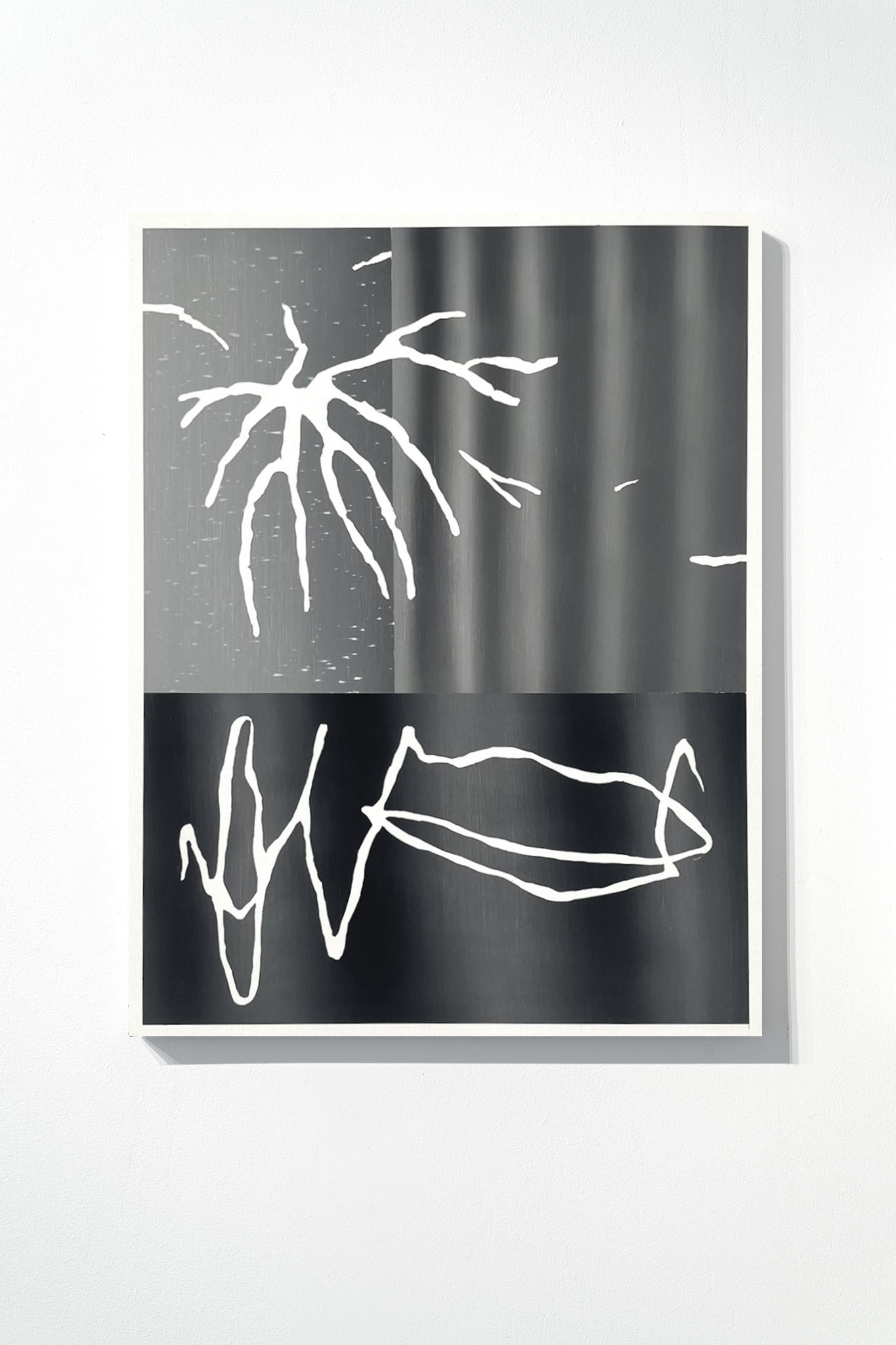
Burst
2023, oil on canvas,
50 x 40 cm
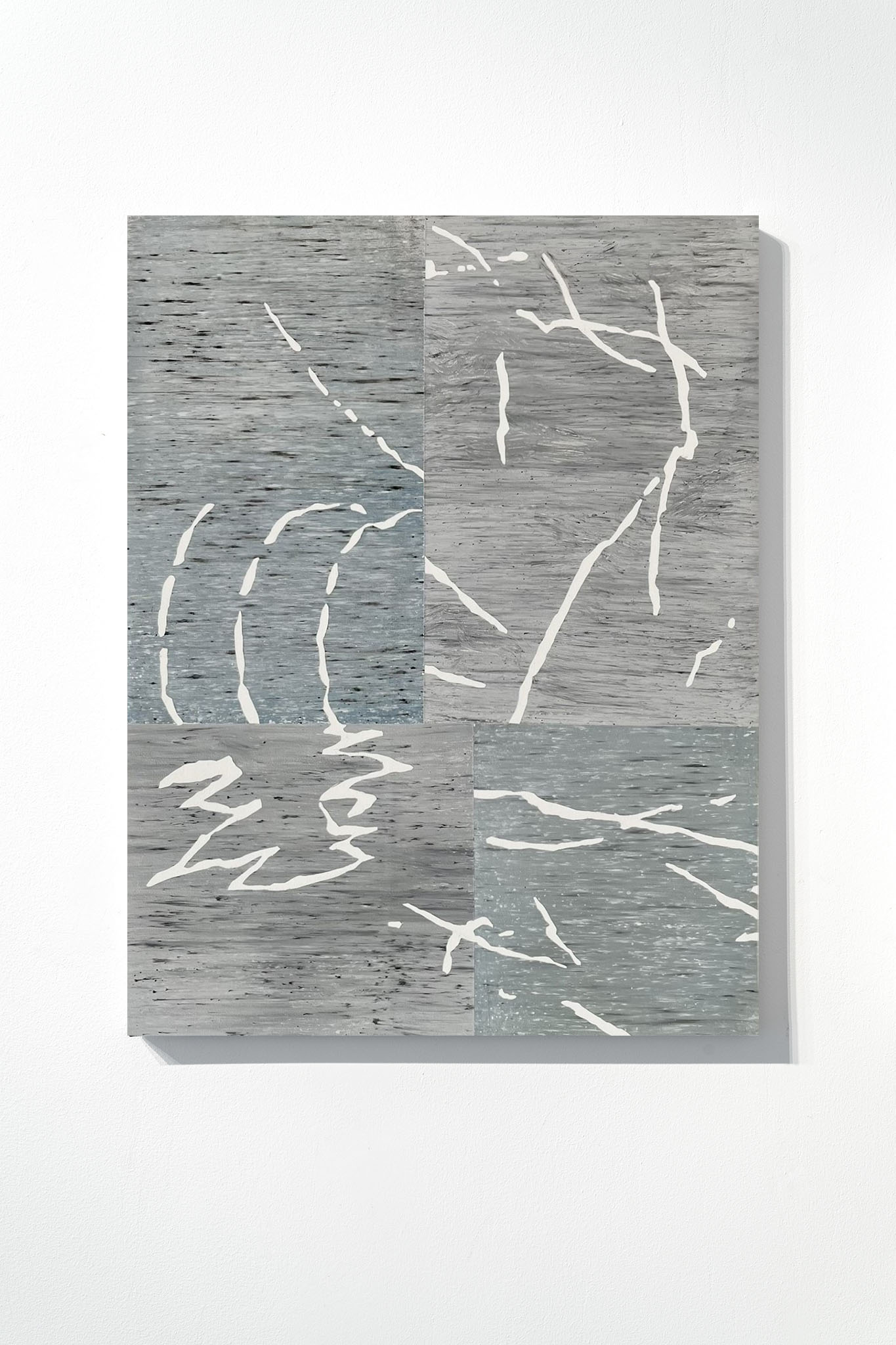
Holy Water
2022, oil on canvas,
50 x 40 cm
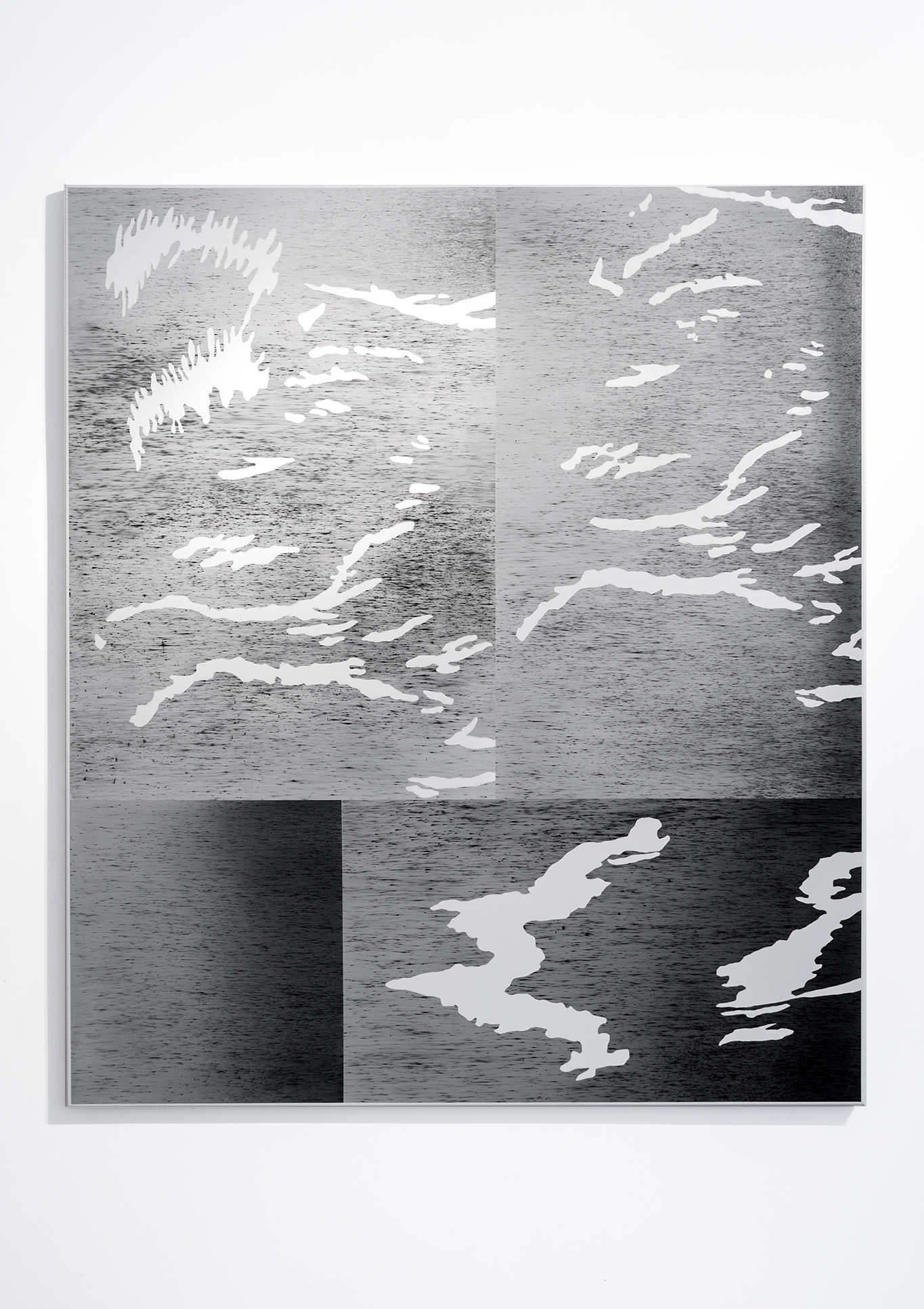
Shifting Gravity
2021, oil on canvas,
150 x 130 cm
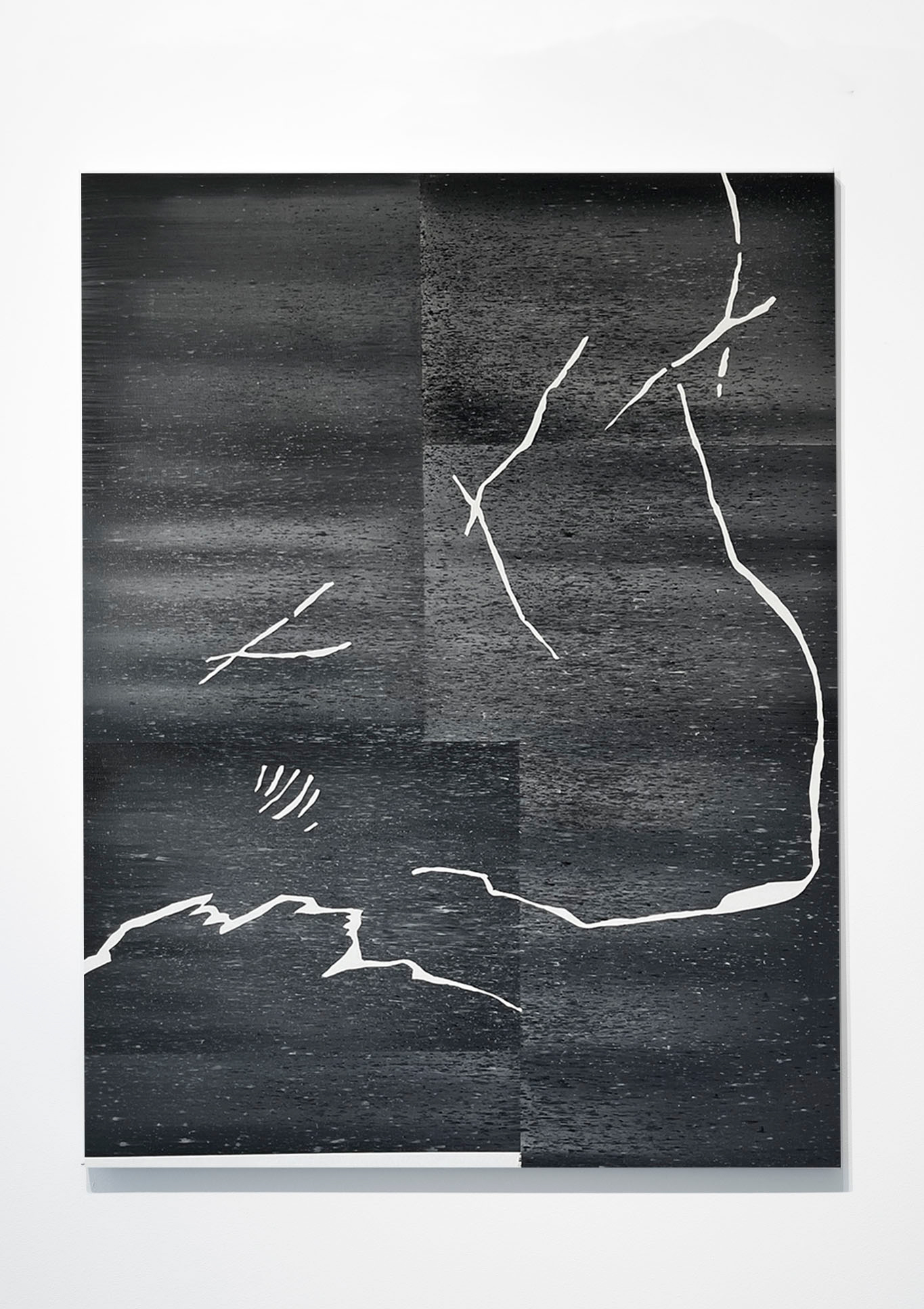
Elements
2023, oil on canvas,
80 x 60 cm